India hits back at Pakistan at UN, says terrorism, ‘duplicity’ will have consequences
India on Saturday launched a sharp counterattack on Pakistan at the UN General Assembly, accusing Islamabad of hypocrisy on democracy, religious freedom and human rights, rejecting its claims on Jammu and Kashmir and warning that continued cross-border terrorism would have consequences.
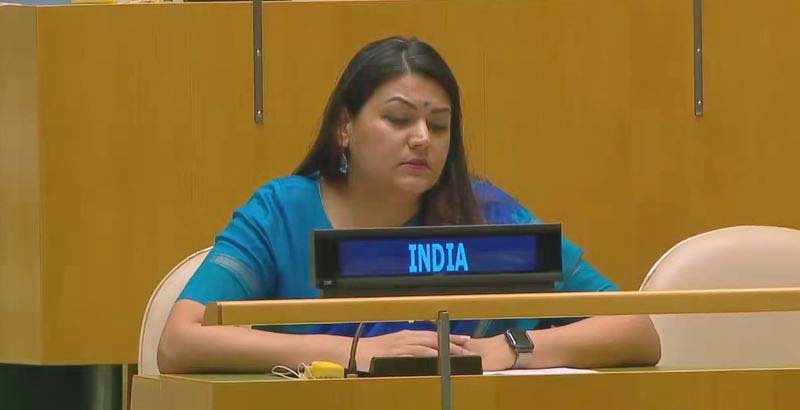
Exercising India’s Right of Reply at the 81st session of the UN General Assembly, First Secretary Petal Gahlot also criticised Pakistan’s military establishment and political leadership, accusing the country of supporting terrorism while preaching security to the international community.
Her intervention came after Pakistan Prime Minister Shehbaz Sharif, in his address to the General Debate, accused India of violating Pakistan’s rights over Indus waters and raised the Kashmir issue, while alleging religious persecution and rights violations in India.
Responding, Gahlot said the Pakistani representative had made “bizarre remarks” and pointed to the presence of Osama bin Laden in Pakistan near the country’s premier military academy
“…This context is important to bear in mind, Mr President, because the 9/11 mastermind, Osama bin Laden, was living right on the doorstep of the Pakistan Army’s premier academy — the very entity to which the representative of Pakistan paid such deep obeisance here today,” she said.
Gahlot also criticised what she described as the military’s dominance over Pakistan’s political system, saying the country’s leadership was that of an establishment “by the army, and for the army”.
“Their puppets may come and go, but let us harbor no illusions about who calls the shots,” she said.
She referred to Pakistan’s 27th Amendment and what she described as lifelong immunity for the country’s “true ruler”, questioning Islamabad’s claims on democracy and constitutional governance.
India rejects Pakistan’s Kashmir claims
Gahlot rejected Pakistan’s references to Jammu and Kashmir, asserting that the Union Territory was an “integral and inalienable part” of India.
She instead drew attention to Pakistan-occupied Jammu and Kashmir and asked the international community to look at the situation there, including what she described as killings, violence and denial of basic rights.
“Ask the people of Rawalakot about the wanton killings, the brutal violence, and the denial of basic rights that they have long experienced,” she said.
Sharif, in his UN address, had called for a resolution of the Kashmir dispute and alleged decades of rights violations, including arbitrary detention, extrajudicial killings, enforced disappearances and collective punishment.
India puts cross-border terrorism at centre of response
Gahlot said Pakistan’s “long-standing practice” of cross-border terrorism remained at the heart of the dispute and warned that India would continue to exercise its right to defend itself against terrorism.
“We demonstrated last year that terrorists will have nowhere to run and nowhere to hide,” she said.
“Our right to defend ourselves against terrorism will be exercised, and continued terrorism by Pakistan will have consequences.”
She added that continued terrorism could also undermine what had previously been premised on friendship and goodwill between the two countries.
The exchange came against the backdrop of Sharif’s warning in his UN speech that any attempt by India to stop, impede or divert Pakistan’s share of the Indus river waters would be treated as an “act of war”.
Sharif described the Indus river system as the lifeblood of Pakistan and argued that India’s decision to hold the Indus Waters Treaty in abeyance had no legal basis. He also invoked Pakistan’s right to self-defence and referred to US President Donald Trump’s intervention in averting a wider conflict between the two nuclear-armed neighbours.
Gahlot did not directly engage with the legal arguments over the Indus Waters Treaty in her Right of Reply, instead focusing India’s response on terrorism, Kashmir and Pakistan’s domestic political and human-rights record.
India accuses Pakistan of hypocrisy
Gahlot also rejected Pakistan’s broader portrayal of itself before the international community, accusing its leadership of hypocrisy over democracy, minority rights and human values.
“The world knows how minorities are treated in Pakistan. No pious platitude can mislead it,” she said.
She said Pakistan’s statements at the UN could not obscure what India described as its record on terrorism and minority rights.
“We are confident that this Assembly will recognize Pakistan and its policies for what they really are — not what its representative mendaciously projects them to be,” she said.
Gahlot ended by saying that repeatedly making the same allegations would not make them true.
“Reiterating falsehoods year after year does not make them true,” she said, adding that Pakistan’s “terrorism, deceit, and duplicity” would benefit neither the country nor the wider world